ANZACDAYADELAIDE2010&2011

  • Home
  • About us
  • Mission
  • News
  • Directions
  • Contact us
  • Blog
  • EACH OF THE FOLLOWING IS A PAGE COVERING A SUBJECT
  • JUST CLICK THE ONE THAT YOU WANT TO USE
  • Photographs-Anzac-Day-2011 - CLICK HERE
  • 27th BATTALION - SOUTH AUSTRALIA
  • 2-27 BATTALION AIF - CLICK HERE
  • 460 SQUADRON RAAF - WWII - CLICK HERE
  • G FOR GEORGE 460 SQUADRON RAAF WWII
  • ROYAL SOUTH AUSTRALIAN REGIMENT
  • ADELAIDE UNIVERSITIES REGIMENT
  • 2-43rd-Battalion-AIF---South-Australia
  • 10th Battalion AIF - SOUTH AUSTRALIA
  • 2-10th-battalion-2-aif---adelaide-rifles
  • WAR MEMORIALS OF ADELAIDE - 1 - PHOTOGRAPHS
  • Photographs 2010 ANZAC DAYADELAIDE
  • RAAF---A- WWII TRIBUTE
  • HISTORY OF RAN
  • RAN - A TRIBUTE
  • New Zealand in the Korean War
  • THE BATTLE OF KAPYONG - KOREA
  • 454 SQUADRON - RAAF
  • 459 SQUADRON RAAF
  • CAPT REG SAUNDERS - OUR FIRST ABORIGINAL OFFICICER
  • Australia and The Great Depression-Prelude To WW2
  • Australia and WWII - Overview
  • Lesser Known RAAF Aircraft 1 - Martin Baltimore


Reg Saunders

From Wikipedia, the free encyclopedia
 
Reg Saunders
7 August 1920 – 2 March 1990(1990-03-02) (aged 69)
Reg Saunders (003967).jpg
Reg Saunders in 1940
Place of birth Framlingham, Victoria
Place of death Sydney, New South Wales
Allegiance Australia Australia
Service/branch Australian Army
Years of service 1940–1945
1950–1954
Rank Captain
Battles/wars

Second World War

  • North African Campaign
  • Battle of Greece
  • Battle of Crete
  • New Guinea campaign
  • Salamaua-Lae campaign

Korean War

  • Battle of Kapyong
Awards Member of the Order of the British Empire
Other work Office of Aboriginal Affairs as a liaison and public relations officer

Reginald Walter Saunders MBE (7 August 1920 – 2 March 1990) was the first Aboriginal commissioned officer in the Australian Army. Enlisting as a soldier in 1940, he served during World War II in North Africa, Greece and Crete before being commissioned as a lieutenant and serving as a platoon commander in New Guinea in 1944–45. After World War II Saunders was demobilised and returned to civilian life, however, he later served as a company commander with the 3rd Battalion, Royal Australian Regiment (3 RAR) during the Korean War. He eventually left the Army in 1954 and later worked as a liaison officer in the Office of Aboriginal Affairs, and was appointed MBE for his services in 1971. He died in 1990 aged 69.

Contents

  • 1 Early life
  • 2 Second World War
  • 3 Korean War
  • 4 Later life
  • 5 Notes
  • 6 References

 Early life

Saunders was born near Purnim on the Framlingham Aboriginal Reserve in western Victoria on 7 August 1920.[1] Saunders' father, Chris, was a veteran of the First World War and he was also the nephew of William Reginald Rawlings who received a Military Medal for his services with the 1st AIF in France.[2]

Following the death of his mother in 1924,[3] Saunders was raised by his grandmother at Lake Condah in Victoria.[4] He attended school only rarely and by the age of 14 he took work in a sawmill as a millhand,[3] but dreamt of travelling overseas to fight for oppressed and impoverished people with whom he could identify.[1]

 Second World War

Following the outbreak of the Second World War, Saunders enlisted in the 2nd AIF on 24 April 1940.[1][5] After completing initial training he was allocated to the 2/7th Battalion, which was serving overseas in North Africa at the time.[6] Saunders' natural leadership qualities led to him being promoted quickly. Within six weeks of enlistment he was promoted to lance corporal, within three months he had made sergeant.[3]

In early April 1941 the 6th Division was sent to Greece to help defend against German invasion. After a series of withdrawals the battalion was evacuated on 26 April and after the ship they were travelling on was bombed and crippled by German aircraft, they were taken under tow by British destroyers and landed on Crete.[6] Following the Invasion of Crete in May the 2/7th Battalion were initially used to defend the coastline before taking part in the fighting around Canea and later carrying out a bayonet charge at 42nd Street that briefly checked the German advance.[6] As the Allies began an evacuation, the 2/7th were called upon to carry out a series of rearguard actions. After the final Allied ships departed the island on 1 June 1941, the 2/7th were left behind.[6] Many of its men were taken prisoner although some were able to evade capture by hiding out in the hills and caves around the island. With the help of a number of local inhabitants Saunders himself managed to remain hidden for twelve months.[1][2]

Reg Saunders and Tom Derrick VC congratulate each other on receiving their commissions. The two men shared a tent during their officer training.

Saunders managed to escape from Crete in May 1942[1] and returned to Australia, rejoining the 2/7th, which had been reformed in Palestine before being brought back from the Middle East to help defend against the threat posed by Japan's entry into the war.[6] Saunders subsequently fought in the Salamaua-Lae campaign, where while serving as a platoon sergeant he took over command of a platoon when his platoon commander was wounded. For his leadership, he was recommened for a commission by his commanding officer.[3] Undertaking a 16-week course at an officer training unit in Australia, Saunders was promoted to lieutenant in November 1944, becoming the first Aboriginal commissioned officer in the Australian Army.[1][7] His commission had caused the Army some trepidation due to its "special significance", finally going before the Commander-in-Chief, General Sir Thomas Blamey, for approval.[8] Nevertheless, Blamey is reported to have "insisted upon following the usual procedure"[3] and, after his promotion was confirmed, Saunders returned to New Guinea and rejoined the 2/7th, taking part in the Aitape-Wewak campaign and commanding a platoon until the end of the war.[2]

 Korean War

Saunders leading his company forward during March 1951

With the end of the Second World War, Saunders was discharged from the Army on 5 October 1945,[5] and returned to Australia. There he learnt that his young brother Harry, with whom he had enlisted in 1940, had been killed in action.[1] Saunders volunteered for service in Japan with the British Commonwealth Occupation Force, but the government would not accept Aborigines for this operation.[8] In the ensuing years he worked as a shipping clerk and a builder's labourer before rejoining the Army when the Korean War began.[1]

Promoted to captain, Saunders served with the 3rd Battalion, Royal Australian Regiment commanding 'C' Company during the Battle of Kapyong in April 1951.[2] He returned to Australia in November 1951.[9]

 Later life

Following the end of the war, Saunders remained in the Army overseeing training for national servicemen. However, he soon became dissatisfied and in 1954 he was discharged from the Army and went to work in the logging industry in Gippsland in Victoria.[1] After this he moved to Sydney, New South Wales where he worked with the Austral Bronze Company until 1967.[1] Due to his achievements Saunders was seen by many as a role model and spokesman for Aboriginal Australians; in 1967 he took up a position in the Office of Aboriginal Affairs as an Aboriginal Liaison Officer.[2] He also became involved in the Returned and Services League.[4] In the Queen's Birthday Honours of June 1971 his community work was recognised when he was appointed Member of the Order of the British Empire (Civil Division).[10][11]

A well-respected soldier, leader and spokesman for the Aboriginal community, Saunders was married twice, with both marriages ending in divorce. He was the father of ten children, two of whom predeceased him. He died on 2 March 1990.[1]

 Notes

  1. ^ a b c d e f g h i j k "Captain Reginald Walter Saunders, MBE". Australian War Memorial. http://www.awm.gov.au/people/302.asp. Retrieved 2009-07-21. 
  2. ^ a b c d e "Reginald Walter Saunders, MBE (1920–1990)". Fifty Australians. Australian War Memorial. http://www.awm.gov.au/fiftyaustralians/43.asp. Retrieved 2008-03-19. 
  3. ^ a b c d e Hall 1997, p. 65.
  4. ^ a b "Captain Reginald Saunders". Australian Broadcasting Corporation South West Victoria. http://www.abc.net.au/local/audio/2009/06/23/2604778.htm. Retrieved 2009-07-21. 
  5. ^ a b "WW2 Nominal Roll: Service Record for Reginal Walter Saunders". Australian Government. http://www.ww2roll.gov.au/script/veteran.asp?ServiceID=A&VeteranID=789823. Retrieved 2009-07-21. 
  6. ^ a b c d e "Unit Information — 2/7th Battalion, Second World War". Australian War Memorial. http://www.awm.gov.au/units/unit_11258.asp. Retrieved 2009-07-21. 
  7. ^ Dexter 1961, p. 24.
  8. ^ a b Dennis et al 2008, p. 478.
  9. ^ "Nominal Roll of Australian Korea War Veterans: Service Record of Reginald Walter Saunders". Australian Government. http://www.koreanroll.gov.au/veteran.aspx?id=1216665. Retrieved 2009-07-21. 
  10. ^ London Gazette: (Supplement) no. 45385, p. 5994, 4 June 1971. Retrieved 28 July 2009.
  11. ^ "Australian Honours Database Search: Saunders, Reginald Walter". Australian Government. http://www.itsanhonour.gov.au/honours/honour_roll/search.cfm?aus_award_id=1086128&search_type=advanced&showInd=true. Retrieved 2009-07-21. 

 References

  • Dennis, Peter; Grey, Jeffrey; Morris, Ewan; Prior, Robin (2008) [1995]. The Oxford Companion to Australian Military History. South Melbourne, Victoria: Oxford University Press. ISBN 0195517849. 
  • Dexter, David (1961). Australia in the War of 1939–1945. Series 1 (Army) Volume VI – The New Guinea Offensives. Canberra: Australian War Memorial. http://www.awm.gov.au/cms_images/histories/22/chapters/02.pdf. 
  • Hall, Robert (1997) [1989]. The Black Diggers. Canberra: Aboriginal Studies Press. ISBN 0855753196. 
Persondata
Name Saunders, Reg
Alternative names
Short description
Date of birth 7 August 1920
Place of birth Framlingham, Victoria
Date of death 2 March 1990
Place of death Sydney, New South Wales
Retrieved from "http://en.wikipedia.org/wiki/Reg_Saunders"
Categories: 1920 births | 1990 deaths | Indigenous Australian people | People from Victoria (Australia) | Australian Army officers | Australian military personnel of World War II | Australian military personnel of the Korean War | Members of the Order of the British Empire
 
...................................................
 
http://cas.awm.gov.au/item/ART28159
 
AUSTRALIAN WAR MEMORIAL

ART28159 - Captain Reg Saunders

ART28159

Image copyright: © Australian War Memorial

ID number
ART28159
Title
Captain Reg Saunders
Artist
Thalben-Ball, Pamela
Object type
Painting
Places made
  • Australia: Australian Capital Territory, Canberra;
  • Australia: New South Wales, Sydney;
Date made
1978
Medium
oil on canvas
Measurement
Overall: 76.4 x 61.6 cm
Collection
Art
Description
Reginald Walter Saunders was born in 1920, in Purnim, Victoria, near the Framlingham Aboriginal Reserve. He came from a long line of soldiers. Both his father and his uncle served in the First World War. His uncle, Reg Rawlings, for whom he was named, received a Military Medal for action at Morlancourt Ridge, France. Rawlings was killed in action at Vauvillers, in 1918. In the Second World War, Reg Saunders and his brother Harry both served in the army. Harry was killed in action in New Guinea. Reg saw action in North Africa at Benghazi, in Greece, and 12 months behind the lines on Crete. After returning to Australia, he saw service on the Kokoda Track was shot in the knee but returned to the 2/7th Infantry Battalion after his recovery. He was the first indigenous Australian to be commissioned as an officer into the Australian Army, in 1945. In Korea, he served as Officer Commanding, C Company, 3 RAR, leading his company through fierce fighting, including the battle at Kapyong in April 1951 for which the battalion was awarded a US Presidential Unit Citation. After having fought the battle for Hill 317, Reg finally left Korea in October 1952, and resigned from the regular army in 1954. He was the first Aboriginal serviceman to command a rifle company, and was respected and popular with his men. His biographer and friend, Harry Gordon, an Australian journalist in Korea, wrote of him: 'He was accepted unreservedly by the men who served with him because false values do not flourish among front-line soldiers.' Saunders was awarded a MBE in 1971 and he died in 1990.
Permalink: http://cas.awm.gov.au/item/ART28159
 
..........................................................................
 
http://www.awm.gov.au/exhibitions/korea/faces/saunders/
 
AUSTRALIAN WAR MEMORIAL


Out in the Cold: Australia's involvement in the Korean War

  • Home
  • Timeline
  • Origins
  • Australians in Korea
  • Australian Operations
  • Weapons of War
  • Faces of War
  • Armistice and Aftermath
  • Glossary
  • Australian POWs in Korea
  • Australian Journalists in Korea
  • Australian Relations with Korea
  • On the Homefront

Captain Reg Saunders

“Reg Saunders was one of the best company commanders I had served under and he was admired by the company as an excellent leader.”

Private Joe Vezgoff

ART 28159Pamela Thalben-Ball,
Captain Reg Saunders
ART28159

Many Aboriginal Australians have been a part of the Australian armed forces since the Boer War. Although not permitted to become Australian citizens until 1968, service in the armed forces was one area where Aborigines experienced less discrimination than in the wider Australian society. Captain Reg Saunders, MBE, is perhaps Australia's best known Aboriginal soldier, being the first indigenous Australian to be commissioned as an officer into the Australian Army, in 1945. In Korea, he served as Officer Commanding, C Company, 3 RAR.

“Saunders quickly established himself and won wide respect for his abilities as a platoon commander, particularly for his determination when leading patrols far from the battalion's main position.”

Robert O'Neill, Official Historian of Australia in the Korean War

Reg Saunders was born in 1920, in Purnum, Victoria, near the Framlingham Aboriginal Reserve. He came from a long line of soldiers. Both his father and his uncle served in the First World War. His uncle, Reg Rawlings, for whom he was named, received a Military Medal for action at Morlancourt Ridge, France. Rawlings was killed in action at Vauvillers, in 1918.

In the Second World War, Reg Saunders and his brother Harry both served in the army. Harry was killed in action in New Guinea. Reg was shot in the knee in a separate action, but returned to the 2/7th Infantry Battalion after his recovery.

When he joined up again for service in Korea, Reg led his company through fierce fighting, including the battle at Kapyong in April 1951. He was the first Aboriginal serviceman to command a rifle company, and was respected and popular with his men. His biographer and friend, Harry Gordon, an Australian journalist in Korea, wrote of him:

“He was accepted unreservedly by the men who served with him because false values do not flourish among front-line soldiers.”

Reg Saunders commented:

“The Americans had negro officers, but they handled negro troops. Sometimes it was suggested to me that Australia should have its own Aboriginal battalion. I'm dead against the idea … it would mean a line of demarcation - a separateness. They would be treated as something apart, and that would be bad.”

After service in Korea, Saunders remained in the regular army for a year before resigning his commission. Returning to civilian life proved a difficult transition. Having been accustomed to leading others in difficult and dangerous situations, and to being a respected and admired officer, when he returned to Australian society he faced discrimination; his qualities as leader went unappreciated. After years of difficulty, he had a successful career working for the Aboriginal Affairs Office and later at the Department of Aboriginal Affairs. He died in 1990.

Cecil Fisher was another Aboriginal Australian who fought in Korea, joining up at the age of 18 years and 10 months to serve with 2 RAR. His poem, “Black ANZAC”, draws on his experiences in the Korean War.

Black ANZAC

They have forgotten him, need him no more
He who fought for his land in nearly every war
Tribal fights before his country was taken by Captain Cook
Then went overseas to fight at Gallipoli and Tobruk

World War One two black Anzacs were there
France, Europe's desert, New Guinea's jungles, did his share
Korea, Malaya, Vietnam again black soldier enlisted
Fight for democracy was his duty he insisted

Back home went his own way not looking for praise
Like when he was a warrior in the forgotten days
Down on the Gold Coast a monument in the Bora Ring
Recognition at last his praises they are starting to sing

This black soldier who never marches on ANZAC Day
Living in his Gunya doesn't have much to say
Thinks of his friends who fought some returned some died
If only one day they could march together side by side

His medals he keeps hidden away from prying eyes
No one knows, no one sees the tears in his old black eyes
He's been outcast just left by himself to die
Recognition at last black ANZAC hold your head high

Every year at Gold Coast's Yegumbah Bora Ring site
Black ANZAC in uniform and medals a magnificent sight
The rock with Aboriginal tribal totems paintings inset
The Kombumerri people's inscription of LEST WE FORGET

AWM P01813.703
Captain Reg Saunders leads his troops in Korea,
March 1951. P01813.703


AWM P1695.001
Private William Reginald Rawlings, MM. P01695.001

AWM 083167
Seymour Vic., 25 November 1944.
Lieutenant Reg Saunders (second from left) at the graduation ceremony from the officers' cadet training unit. 083167

...........................................................................................

http://www.abc.net.au/local/audio/2009/06/23/2604778.htm

23 June, 2009 8:21AM AEDT

Captain Reginald Saunders

By Jeremy Lee

The story of Captain Reginald Saunders is a great piece of inspiring local history which rises above prejudice and celebrates leadership.

23 June, 2009 8:21AM AEDT

Captain Reginald Saunders

By Jeremy Lee

The story of Captain Reginald Saunders is a great piece of inspiring local history which rises above prejudice and celebrates leadership.

  • Print Print
  • Email Email this
  • Share Share
  • Permalink Permalink
Download this mp3 file

Reg Saunders was born near Framlingham in Victoria's south west and grew up at the Lake Condah Mission.

Fuelled by stories of the first world war, he enlisted in the AIF in 1940 and went on to become a highly regarded and respected member of our armed forces.

He was the first Aboriginal to be promoted to a commissioned rank, and was awarded an MBE in 1971.

Later in his life he worked at the Department of Aboriginal Affairs, and was also closely involved with the RSL.

Recently his life and achievements were recognised in Canberra when the Canberra Services Club dedicated a room to him.

In this interview one of his daughters, Glenda Humes, talks more about her father's life and her memories of him.
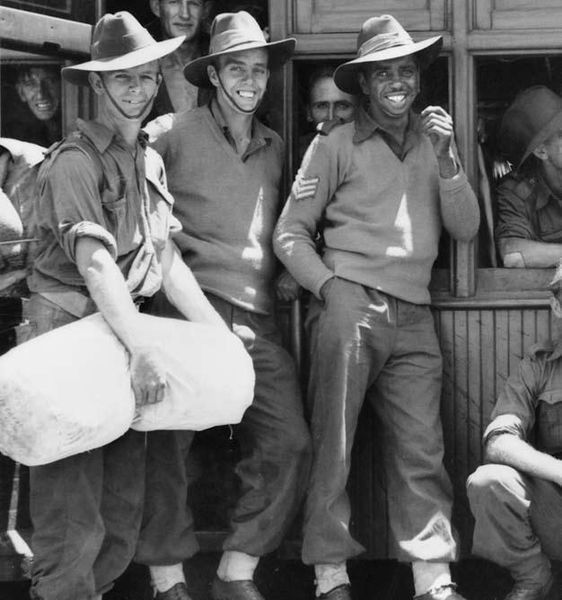
Captain Reg Saunders (on the far right) (James Tait - Australian War Memorial)

..........................................................................................

http://www.youngdiggers.com.au/capt-reg-saunders

YOUNG DIGGERS

CAPT Reg Saunders (Aboriginal hero) by David Delaney

CAPT Reg Saunders (Aboriginal hero) by David Delaney

The nineteen twenty’s saw his birth,
out in Victoria’s wild west,
raised by his loving grandmother,
he passed with ease his manhood test.

From the Gunditjmara tribe,
upon the Framlingham reserves.
I’ll try to honour this great man,
and in a way he so deserves.

While at the sawmill working hard,
continued yearnings grew within,
to fight for south Americans,
for him they always felt like kin.

Instead this proud Australian lad,
who’s now, nineteen years old at least,
signs up, for the world’s second war,
then shipped out to the middle east.

Surviving German aircraft strikes,
he thinks he’s granted a release.
Sent to the European fight,
the conflict being fought in Greece.

Now this disastrous doomed campaign
for many allies now on Crete,
orders were given to retreat
while facing imminent defeat.

This hero Aboriginal,
whose strength with family regains,
again he joins battalion mates,
now fighting in New Guinea’s rains.

Received promotions from the ranks,
then leads his men as sergeants do,
respected by them all because,
he was not false, but just true blue.

Within the final months of war,
now leader of his own platoon,
He misses family and home,
and peaceful nights beneath the moon.

Heard how his brother won’t return,
they’ll never share a fire at night.
He lies now in a jungle grave,
killed in Kokoda’s deadly fight.

Home working as a shipping clerk
now finds it hard to settle down,
he then works as a labourer
at building sites around the town.

When the Korean war began
he quickly signed up once again,
farewelled his children and his wife
hopes one day soon to be with them.

Returns a Captain of his men
the 3rd battalion R.A.R.
And won the hearts of those with him,
best leader they all had by far.

He fought the battle of Kapyong,
recorded by historians,
outnumbered drove the Chinese back,
those Aussies and Canadians.

Once, he was interviewed and asked,
about Australia’s own and bred
indigenous battalion group,
so, now I quote what he then said.

---------------------------------------------

'The Americans had negro officers,
but they all mostly handled negro troops.
I’m dead against the idea,
it would mean demarcation and a separateness.
They would be treated as something apart,
that would be bad and break my heart'.

----------------------------------------------

Resigned in nineteen fifty four
worked in the logging industry,
he then moved onto Sydney’s shore
this famous Aborigine.

I know I tribute just one man
when many ‘Aussie’s’ gave their life,
although they’re Aboriginals
they were as one through all the strife.

I sometimes sit in disbelief
why Aussie’s don’t know more of Reg.
And how, himself made history
reciting his first soldier’s pledge.

When honouring our Aussie greats,
include within their company,
these men who walked their same footsteps
our true blue Aborigine.

David J Delaney

26 May 2010 ©


This free website was made using Yola.

No HTML skills required. Build your website in minutes.

Go to www.yola.com and sign up today!

Make a free website with Yola